
The current MadeWithStack catalog shows a founder tech stack clustered around web delivery, managed backend, and AI workflow tools — and founders who ignore that pattern risk choosing tools that add architecture before the product has earned it.
| Your Situation | What to Do | Key Number | Where to Start |
|---|---|---|---|
| Choosing a first production stack | Start from the most repeated web and deployment pair | 8 products use Next.js + Vercel | Read the catalog signal before choosing tools |
| Adding backend state | Keep auth, data, and storage close to the product workflow | 6 products use Supabase + Vercel | Use the base layer only when the product needs it |
| Building with AI assistance | Separate build-loop tools from product-runtime AI | 9 products use Claude; 7 use Cursor | Split the founder stack into operating layers |
| Comparing stack complexity | Count adjacent tools before copying a stack | 5 tools appear in the top recurring set with at least 8 products each | Inspect pairings before recommendations |
| Preparing a public submission | Preserve stack evidence instead of a loose tool list | 1 canonical product page plus stack metadata | Turn the stack into reviewable evidence |
Founders often ask for a stack before they have named the product shape. The approved MadeWithStack catalog gives a narrower answer: start with the tools repeated across shipped products, then decide which layers the product actually needs. This guide uses the current 53-product catalog to separate durable stack signals from generic founder-tool advice.
Read the catalog signal before choosing tools
The current approved catalog has 53 products. The strongest individual tool signals are Next.js on 14 products, Vercel on 11, React on 10, Claude on 9, GPT-4 and Tailwind CSS on 8 each, and Cloudflare, Cursor, and Supabase on 7 each.
That does not prove a universal founder stack. It does show which choices are common enough in this directory to treat as serious defaults rather than isolated examples.
Use repeated tools as a starting filter. If a founder wants a practical web-product stack, the catalog supports starting with an application framework, a deployment path, a backend boundary, and any AI tooling the workflow genuinely needs. Next.js, Vercel, React, Supabase, Claude, Cursor, and Cloudflare are useful because they appear across multiple approved listings instead of only inside one launch story.
The drawback: repeated tools can still be the wrong tools when the product is not web-first, needs long-running workers from day one, or depends on infrastructure that is not visible in the public stack evidence.
Split the founder stack into operating layers
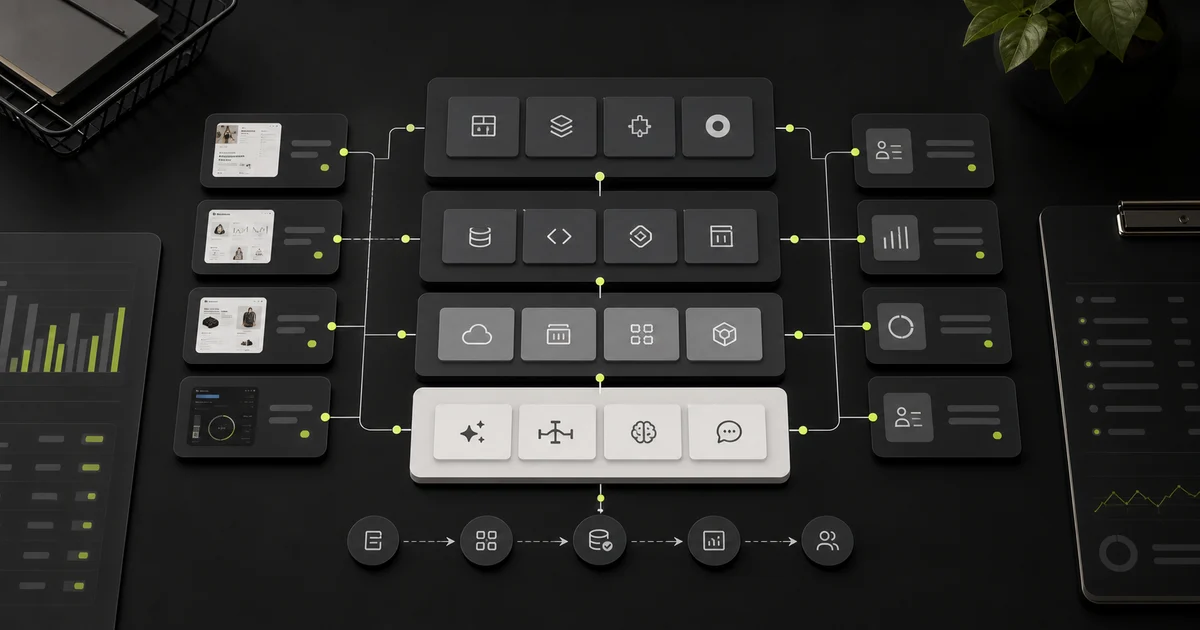
A founder tech stack is easier to reason about when it is split into operating layers. The catalog points to four practical layers: product surface, deployment and delivery, backend and data, and AI workflow support.
Treat the product surface as the first decision. The strongest current signal is a web-app surface: Next.js appears on 14 products and React appears on 10. That makes the application layer the first place to check when comparing founder-led products such as ACE ZERO TRADING, GigScale, LaunchWall, Hermit, and Supa Social.
The drawback: a web-app default breaks down when the product is primarily an API, a desktop workflow, a voice agent, or an infrastructure layer where the public interface is not the core product.
Treat deployment as an operating choice, not a badge. Vercel appears on 11 products, and the Next.js + Vercel stack is the strongest indexable pair with 8 products. That pairing shows up around products with different surrounding tools, which makes it a useful base layer to inspect.
The drawback: deployment convenience can hide missing worker, queue, data-region, or observability requirements; founders should not copy the pair if the product already needs process control outside the frontend path.
Treat AI tools as either build-loop or product-runtime tools. Claude appears on 9 products and Cursor appears on 7, but they do not mean the same thing. Cursor often says something about how the founder builds and iterates. Claude can indicate either build support or user-facing AI behavior, depending on the product.
The drawback: grouping all AI tools together makes the stack less reviewable because it blurs whether AI is helping the founder ship, powering the product workflow, or both.
Use the base layer only when the product needs it
The most useful founder stack is not the longest one. It is the smallest set of tools that can support the product's actual workflow, review path, and launch surface.
Start with the strongest pair when the product is web-first. The catalog currently has 8 products in the Next.js + Vercel stack, including Prompt Builder, Founder Lift, FeedPane, Hermit, and Supa Social. That makes the pair a practical default to inspect for founder-led web products.
The drawback: the pair says little about data shape, internal jobs, billing, or AI behavior; it is an application and deployment signal, not a full operating model.
Add Supabase when the product needs owned state. The Supabase + Vercel stack appears on 6 approved products, including Aident AI Beta 2, Hermit, Supa Social, Questy, LaunchWall, and ACE ZERO TRADING. That points to a common founder pattern: managed deployment plus a managed Postgres-backed backend.
The drawback: Supabase is useful only when the product has data, auth, storage, or workflow state that belongs in a durable backend; adding it for a static or content-only launch creates a maintenance surface before the product needs one.
Use Cloudflare when delivery, DNS, or edge behavior matters. Cloudflare appears on 7 products and pairs with React on 6. That makes it relevant for founders whose product surface depends on public performance, edge routing, or a broader network layer.
The drawback: edge and network choices can make debugging harder when business logic starts moving away from the main application boundary.
Inspect pairings before recommendations
The strongest catalog-backed advice comes from pairings, not isolated tool names. A single tool count says a tool appears often. A stack pair says something about how founders combine decisions.
Compare the top pairs before copying a stack. The current indexable leaders are Next.js + Vercel with 8 products, Cloudflare + React with 6, Next.js + Tailwind CSS with 6, React + Tailwind CSS with 6, and Supabase + Vercel with 6. Those pairs point to two repeated operating styles: fast web-product delivery and managed backend support.
The drawback: pair counts flatten product differences; a lightweight directory product, an AI workflow product, and a transactional SaaS can share tools while needing different reliability, data, and review boundaries.
Use adjacent tools to infer product maturity. A small stack can mean the founder is keeping the product intentionally simple. A broader stack can mean the product has grown into payments, email, AI workflows, or edge delivery. LaunchWall, for example, combines frontend, backend, deployment, AI, and design-adjacent tools, while Aident AI Beta 2 keeps the tracked pair tighter around Supabase and Vercel.
The drawback: visible stack breadth is not the same as product quality; it only tells an editor or founder where to inspect the operating assumptions next.
Turn the stack into reviewable evidence
MadeWithStack treats a listing as a trust object, so a founder stack should be more than a loose list of logos. The stack should help a reviewer understand what the product is, how it is built, and which surfaces deserve directory placement.
Submit the stack as structured metadata. A founder or agent submitting a product should use recognized tool slugs where possible, keep custom tools limited to genuinely missing taxonomy entries, and connect the stack to the product's public workflow. The agent submission guide explains how structured intake turns a stack into reviewable evidence instead of a browser-form note.
The drawback: structured metadata only helps when it is accurate; over-tagging every tool a founder has ever touched weakens the review signal and can make the listing harder to trust.
Use the founder infrastructure resource page for decisions the catalog cannot answer alone. The founder infrastructure resources post is better for choosing hosting, backend, automation, monitoring, and launch-check resources. This guide is narrower: it explains what approved products currently repeat.
The drawback: a resource page can help evaluate options, but it cannot replace product-specific judgment about traffic, data model, customer workflow, compliance, or support load.
Start by writing down 4 stack layers for your product: surface, deployment, data, and AI workflow. Then compare each layer against the current catalog leaders before adding a tool: 14 Next.js products, 11 Vercel products, 10 React products, 9 Claude products, and 7 each for Cloudflare, Cursor, and Supabase.